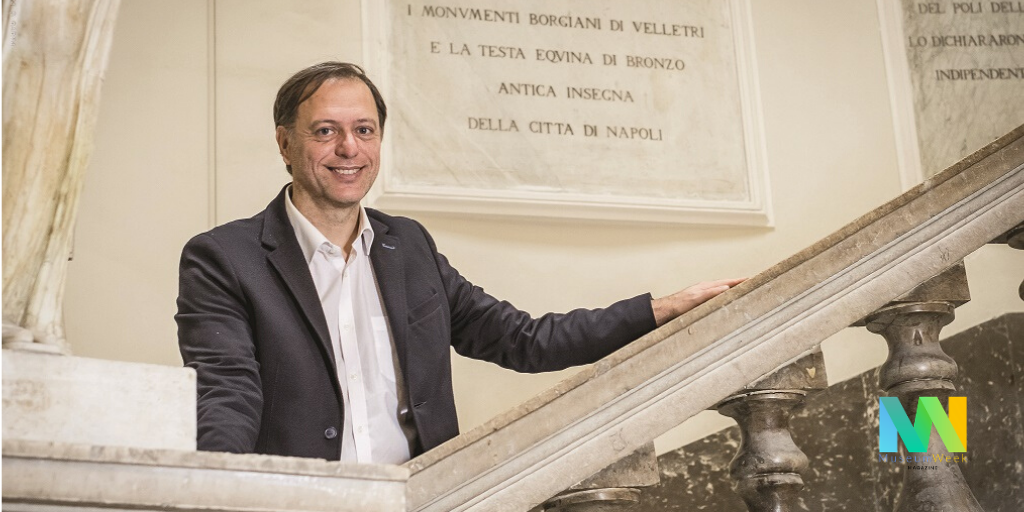
Share the post "6 questions to Paolo Giulierini from Archaeological Museum of Napoli"
1.What is your museum about and what are its challenges?
MANN is a concentrate of the most sublime expressions of classical art: Greek-Roman sculpture, painting and bronzes tell us about a world that has structured the basis of each successive cultural trace of the West. The Institute teaches that without knowledge of the past we are men without a critical sense: this message intends to spread it democratically to everyone, especially to young people in difficulty and the weakest links in the social chain, becoming more and more an open square.
2.What kind of remarkable digital innovation would you like to share with us? It can be online and/or in your physical space.
With over 4 million downloads, the “Father and Son” video game has shown that some innovations speak a universal language and have a viral spread. This is why we have planned a second episode because, among other things, it embraces the ICOM principles of “learning while having fun”.
3.What are the social media platforms that your museum chose for its digital presence and who are your primary target audiences?
We are very active on Facebook and Instagram and, through these platforms, we dialogue with a part of young people that is more difficult to attract. The new technologies we use in social networks also help us: 3D reconstructions, augmented reality, virtual reality, lead to a visit that must also have a strong historical background.
4.If you had to keep one social media platform to reach youngsters, which one would you pick?
Today Instagram prevails, but one must be careful because the image does not express everything. Over time, the word was invented to communicate the nuances: losing this means losing the possibility of expressing the contents well. Museums are also important in overseeing this aspect, concentrating iconography and inscriptions in one place.
5.Tell us how are you facing the coronavirus emergency with the museum? What strategies are you using.
We are organically presenting all the results of these past years on social networks: reopened sections, exhibitions, cartoons, short films and educational activities, trying to maintain a constant dialogue with our audience which, among other things, has over 8000 subscribers; at the same time, we collect considerations and advice: ideas and suggestions, for a new restart.
6.Do you have a professional alter-ego somewhere in the world to whom you would like to ask a professional question?
To the Director of the Bardo Museum − in my opinion one of the absolute novelties in Mediterranean culture − I would like to ask how the Bardo got up after the terrible act of terrorism. She has just arrived, but her strength and enthusiasm, in addition to being a woman (which is not obvious in some contexts), have been the best possible answer to obscurantism.
Interview by Fabio Pariante, journalist
MORE
MANN on social networks: Twitter – Instagram – Facebook – YouTube
Paolo Giulierini (Cortona, 1969) is an Italian archaeologist from Tuscany. He graduated in Etruscology and Italic Antiquities and specialized in classical archeology (1996) at the University of Florence, where he also did teaching. After various positions in Tuscan cultural institutes, from 1 October 2015 he is the Director of the National Archaeological Museum of Napoli, until 2023.
As MANN Director, he planned and curated the reopening of the Egyptian, Epigraphic, Magna Grecia and Prehistory sections. He promoted the restyling of the so-called “New Arm of the museum”, with the rearrangement of the teaching spaces, for the restaurant, the auditorium and the Pompeian Technological Section.
In addition to the contemporary art exhibitions, numerous archaeological retrospectives have been held in the museum, such as those dedicated to the Lombards and Canova. Then many international loans were agreed with which important exhibitions abroad were planned. Giulierini has entered into agreements with the Hermitage of St. Petersburg, the J.P. Los Angeles Getty, the Colosseum Archaeological Park and the Sicily Region. The “Father and son” projects, the first archaeological video game (also in Neapolitan language), and the “Obvia” university program were launched for museum communication.
In 2017, the Italian art magazine Artribune recognized MANN as the best museum in Italy for innovation; in 2018, always Artribune awarded Giulierini the best Director of Italy. He was Interim Director of the Archaeological Park of the Phlegraean Fields, from February 2018 to May 2019.